







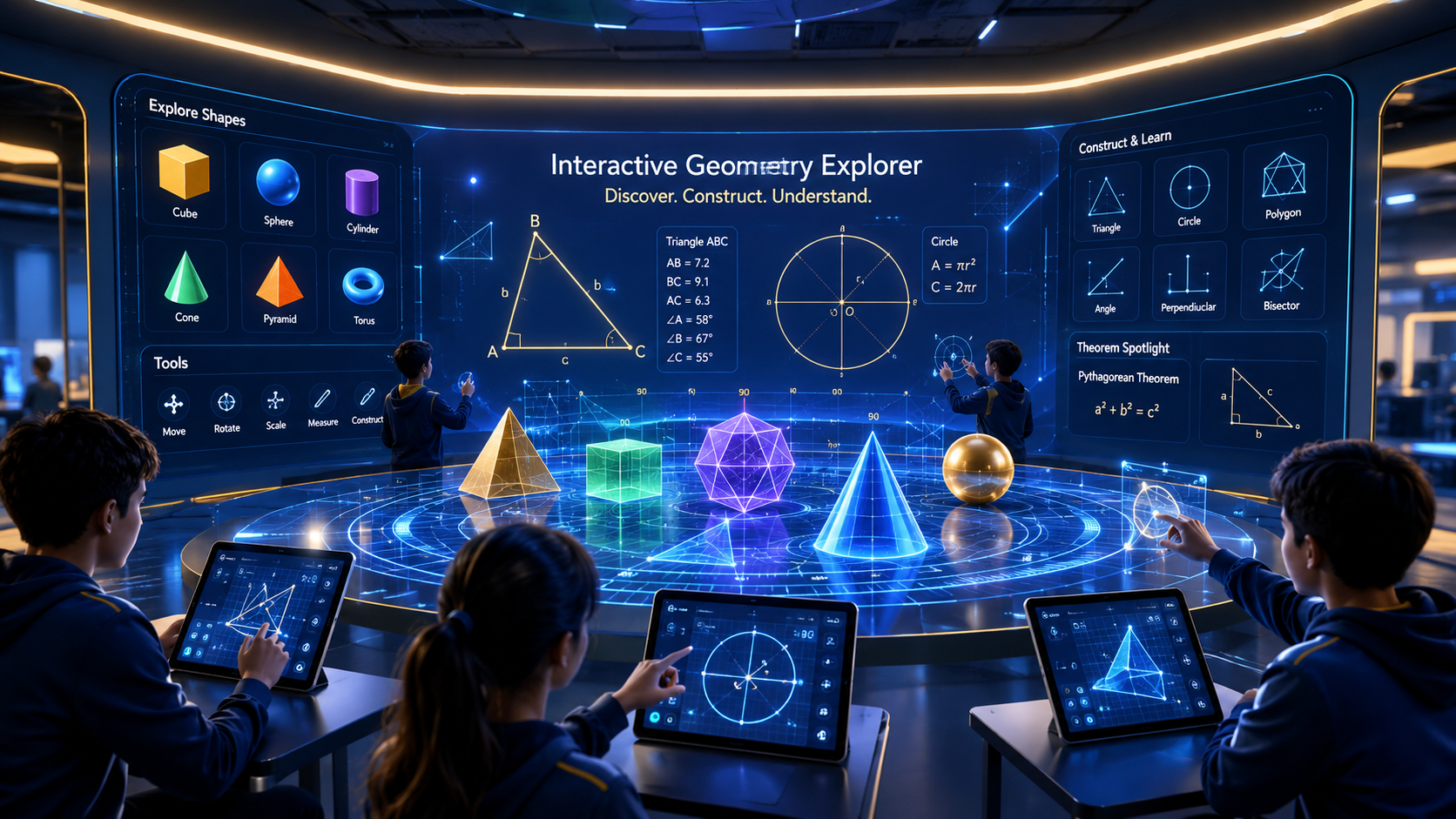
Exploring the Foundations of Geometry Through Innovative Tools
Geometry stands as one of the most captivating branches of mathematics, bridging abstract thought with tangible real-world applications. From the ancient architects who designed the pyramids to modern engineers shaping skyscrapers, geometry provides the language for understanding space, form, and structure. In today’s digital age, platforms like Geometry Learn V3 have emerged to make this timeless subject more accessible, interactive, and enjoyable than ever before.
Geometry Learn V3 represents a significant evolution in educational technology, offering a comprehensive browser-based hub designed specifically for mastering geometric principles. This platform integrates games, dedicated apps, supplementary resources, and customizable settings to create an immersive learning environment. Whether you are a student grappling with basic shapes or an advanced learner exploring complex proofs, Geometry Learn V3 adapts to diverse needs, fostering both conceptual understanding and practical skills.
The appeal of Geometry Learn V3 lies in its seamless blend of entertainment and education. Traditional textbooks often present geometry as a series of static diagrams and formulas, but Geometry Learn V3 transforms these into dynamic experiences. Users manipulate virtual objects, test hypotheses in real time, and receive immediate feedback, turning potential frustration into moments of discovery and achievement.
The Historical Journey Leading to Modern Geometry Education
To fully appreciate the innovations in Geometry Learn V3, it is essential to trace the rich history of geometry. Ancient civilizations laid the groundwork millennia ago. The Egyptians applied geometric knowledge to survey land after Nile floods and construct monumental structures with remarkable precision. Meanwhile, the Babylonians developed sophisticated techniques for calculating areas and volumes.
The Greeks elevated geometry to a philosophical discipline. Euclid’s Elements, compiled around 300 BCE, systematized geometric knowledge into axioms, postulates, and theorems that remain foundational today. Archimedes pushed boundaries with his work on circles, spheres, and mechanical principles, while Pythagoras and his followers explored relationships between sides of right triangles that continue to influence countless fields.
During the Islamic Golden Age, scholars like Al-Khwarizmi and Ibn al-Haytham advanced geometric understanding through algebra and optics. The Renaissance brought renewed vigor, with figures such as Leonardo da Vinci integrating geometry into art and perspective drawing. In more recent centuries, non-Euclidean geometries challenged long-held assumptions, opening doors to relativity and modern physics.
A biography table is very important for contextualizing these contributions and making historical connections accessible within Geometry Learn V3 resources. Such tables typically include:
- Euclid: Greek mathematician, author of Elements, systematized plane geometry.
- Archimedes: Explored circles, pi approximations, and principles of levers.
- René Descartes: Developed analytic geometry, linking algebra and geometry through coordinate systems.
- Carl Friedrich Gauss: Contributed to differential geometry and non-Euclidean explorations.
- Bernhard Riemann: Laid foundations for modern geometry used in general relativity.
By incorporating these biographical insights, Geometry Learn V3 enriches the learning experience, showing students that geometry is not merely abstract rules but a living tradition shaped by brilliant minds across cultures and eras. This historical dimension helps learners appreciate the subject’s depth and relevance.
Core Features That Define Geometry Learn V3
Geometry Learn V3 distinguishes itself through several thoughtfully designed features. At its heart is an intuitive interface divided into clear sections: Games, Apps, Extras, Settings, and a powerful Beta Search function. This organization allows users to navigate effortlessly between different modes of engagement.
The Games section offers interactive challenges that reinforce concepts through play. Users might construct virtual bridges using geometric stability principles, solve puzzles involving angle relationships, or compete in timed challenges testing knowledge of congruence and similarity. These activities leverage gamification elements—progress tracking, achievements, and adaptive difficulty—to maintain motivation and encourage repeated practice.
Dedicated Apps within Geometry Learn V3 provide focused tools for specific topics. One app might allow exploration of transformations—translations, rotations, reflections, and dilations—in a visual canvas where changes update instantly. Another could simulate compass-and-straightedge constructions, guiding users through classical proofs while offering hints and step-by-step visualizations.
Extras include supplementary materials such as animated explanations, printable worksheets, real-world application examples, and community-contributed challenges. Settings enable personalization, from adjusting visual themes and difficulty levels to configuring accessibility options for diverse learners.
The Beta Search functionality stands out as particularly valuable. It permits quick queries across the entire platform, surfacing relevant lessons, practice problems, or related games. This feature proves invaluable during study sessions when students need to cross-reference concepts rapidly.
Deep Dive into Fundamental Geometric Concepts Covered
Geometry Learn V3 excels at breaking down complex ideas into manageable, interconnected modules. It begins with foundational elements: points, lines, planes, and basic shapes. Users learn to identify and classify angles—acute, right, obtuse, and reflex—while experimenting with their properties through interactive protractors and dynamic diagrams.
Triangles receive extensive attention, as they form the building blocks of many geometric proofs. Geometry Learn V3 covers classification by sides (scalene, isosceles, equilateral) and by angles (acute, right, obtuse). Users explore the triangle inequality theorem, Pythagorean theorem applications, and trigonometric ratios in engaging simulations that connect abstract formulas to visual intuition.
Quadrilaterals, polygons, and circles expand the scope. Learners manipulate parallelograms to discover relationships between sides and angles, investigate cyclic quadrilaterals, and calculate arc lengths and sector areas using precise digital tools. Three-dimensional geometry introduces prisms, pyramids, cylinders, cones, and spheres, with cross-section visualizations and volume calculations made tangible through rotatable models.
Advanced topics in Geometry Learn V3 include congruence and similarity criteria (SSS, SAS, ASA, AAS, HL), parallel lines with transversal properties, and circle theorems involving inscribed angles and tangent segments. Coordinate geometry bridges algebra and geometry, allowing plotting of points, determination of slopes, and derivation of equations for lines and conic sections.
Throughout these explorations, Geometry Learn V3 emphasizes proof construction. Rather than memorizing statements, users build logical arguments step by step, receiving scaffolding when needed and celebrating successful demonstrations of understanding.
Benefits of Using Geometry Learn V3 for Different Learners
One of the platform’s greatest strengths is its versatility across age groups and skill levels. Elementary students benefit from colorful, intuitive interfaces that introduce shapes and basic spatial awareness without overwhelming terminology. Middle school learners tackle more structured concepts like area, perimeter, and angle relationships, building confidence through scaffolded challenges.
High school students preparing for standardized tests or advanced coursework find Geometry Learn V3 particularly effective. The platform aligns with common curriculum standards while offering deeper explorations that extend beyond typical classroom pacing. Visual learners appreciate the dynamic diagrams, while kinesthetic learners engage through manipulation of virtual objects.
Educators also gain significant advantages. Teachers can integrate Geometry Learn V3 into lesson plans as a supplementary resource, assign specific modules for homework, or use the platform for differentiated instruction. Real-time progress tracking helps identify areas where students need additional support, enabling targeted interventions.
For self-directed adult learners or those returning to mathematics after a hiatus, Geometry Learn V3 provides a low-pressure environment to refresh skills or explore new interests. The flexible pacing accommodates busy schedules, while the engaging format prevents the monotony often associated with traditional study methods.
Parents seeking to support their children’s education discover in Geometry Learn V3 a valuable ally. The platform’s clear explanations and interactive elements facilitate meaningful discussions about mathematical concepts at home, strengthening family engagement with learning.
Practical Applications of Geometry in Everyday Life and Careers
Geometry Learn V3 consistently highlights real-world connections, demonstrating why mastering these concepts matters beyond the classroom. Architecture and construction rely heavily on geometric principles for structural integrity and aesthetic design. Engineers use coordinate geometry and transformations in computer-aided design software. Artists and designers apply perspective, symmetry, and proportion to create compelling visuals.
In navigation and geography, understanding angles and distances enables accurate mapping and GPS functionality. Sports analysts employ geometric models to optimize player positioning and trajectory calculations. Medical imaging technologies, from MRI to CT scans, depend on geometric algorithms for three-dimensional reconstructions.
Emerging fields like robotics, virtual reality, and 3D printing further amplify geometry’s importance. Professionals in these domains use advanced geometric modeling to simulate environments, design components, and solve spatial problems efficiently. By internalizing concepts through Geometry Learn V3, students position themselves advantageously for future careers in STEM disciplines.
Advanced Techniques and Problem-Solving Strategies Emphasized
Beyond basic instruction, Geometry Learn V3 cultivates higher-order thinking skills. Users learn strategic approaches to geometric proofs, including working backwards from conclusions, identifying auxiliary lines, and applying multiple theorems synergistically. Interactive problem banks present varied scenarios, encouraging creative solution paths rather than rote application of formulas.
The platform incorporates error analysis exercises where learners examine common misconceptions—such as confusing congruence with similarity—and correct flawed reasoning. This metacognitive approach strengthens analytical abilities applicable across all academic subjects.
Collaborative features in some sections allow users to share constructions or solutions, fostering a sense of mathematical community. Peer review activities develop communication skills as students articulate their thought processes clearly and persuasively.
Integrating Geometry Learn V3 with Broader Mathematical Education
While focused on geometry, Geometry Learn V3 naturally connects to other mathematical domains. Algebraic techniques support coordinate geometry explorations. Trigonometry emerges organically from right triangle studies. Data analysis and probability appear in contexts involving geometric probability or statistical modeling of spatial distributions.
This interdisciplinary approach mirrors the interconnected nature of real mathematical practice. Students using Geometry Learn V3 develop a more holistic understanding of mathematics as a unified field rather than isolated topics, enhancing overall computational fluency and logical reasoning.
Tips for Maximizing Your Experience with Geometry Learn V3
To derive maximum benefit from the platform, establish a consistent routine. Begin with foundational modules to ensure solid grounding before progressing to advanced topics. Take advantage of the Settings section to tailor the experience to your learning style and pace.
Engage actively with the material rather than passively observing. Manipulate shapes, test different configurations, and attempt problems before consulting hints. Regular review of previously mastered concepts through the Games section helps maintain long-term retention.
Track your progress using built-in analytics. Identify patterns in areas of strength and challenge, then allocate study time accordingly. Don’t hesitate to revisit earlier modules when encountering difficulties in more complex applications, as geometry builds cumulatively.
Combine Geometry Learn V3 with hands-on activities. Drawing constructions on paper, building physical models with everyday materials, or exploring geometric patterns in nature complements digital learning beautifully.
For educators and parents, leverage the platform’s resources to create enriched learning environments. Assign specific challenges aligned with curriculum goals and facilitate discussions around discovered insights.
Common Challenges in Learning Geometry and How Geometry Learn V3 Addresses Them
Many students struggle with visualization, abstract reasoning, or connecting concepts. Geometry Learn V3 tackles these issues directly through its interactive nature. Dynamic models help develop spatial intuition, while step-by-step breakdowns demystify abstract proofs.
Time management presents another hurdle, particularly when preparing for examinations. The platform’s efficient navigation and targeted practice modules allow focused study sessions that yield significant results without excessive time investment.
Motivation can wane during challenging units. Gamified elements and immediate feedback in Geometry Learn V3 maintain engagement, celebrating small victories and providing clear pathways through difficulties.
Expanding Horizons: Future Developments in Geometric Learning Tools
The evolution of platforms like Geometry Learn V3 points toward even more sophisticated educational technologies. Potential advancements include augmented reality integrations for overlaying geometric constructions onto real environments, artificial intelligence tutors offering personalized guidance, and expanded multiplayer collaborative spaces for group problem-solving.
As these innovations emerge, the core principles established in Geometry Learn V3—interactivity, accessibility, and conceptual depth—will likely remain central. Continued refinement based on user feedback ensures that such tools evolve alongside changing educational needs and technological capabilities.
In-Depth Module Explorations Within Geometry Learn V3
Delving deeper reveals the platform’s meticulous attention to progressive skill development. The introductory modules establish terminology and basic properties with abundant visual support. Subsequent sections build complexity systematically, introducing deductive reasoning and formal proof structures at appropriate stages.
Circle geometry receives particularly comprehensive treatment. Users investigate inscribed and circumscribed polygons, explore power of a point theorems, and analyze relationships between chords, tangents, and secants through animated demonstrations. These experiences solidify understanding while revealing the elegant interconnectedness of geometric properties.
Transformational geometry offers another highlight. Learners experiment with symmetry groups, compose transformations, and explore tessellations, discovering patterns that appear throughout art, nature, and crystallography. Such explorations foster creativity alongside analytical precision.
Supporting Diverse Learning Styles and Accessibility
Geometry Learn V3 incorporates multiple modalities to accommodate varied preferences. Visual learners benefit from rich graphics and animations. Auditory components through narrated explanations reinforce concepts. Kinesthetic engagement comes via drag-and-drop interactions and gesture-based controls where applicable.
Accessibility features ensure inclusivity. Options for text-to-speech, high-contrast modes, adjustable font sizes, and simplified interfaces support users with different needs. Multilingual support broadens reach across global audiences, promoting equitable access to quality geometry education.
Measuring Progress and Achieving Mastery
Effective learning requires clear benchmarks. Geometry Learn V3 provides comprehensive assessment tools ranging from quick quizzes to extended projects. Mastery badges reward consistent performance across multiple competencies, while detailed reports highlight growth over time.
Portfolio-style collections of completed constructions and solved problems allow users to document their journey. These artifacts serve both motivational purposes and practical references for future review or sharing with instructors.
Geometry Learn V3 in Educational Ecosystems
Integration with broader learning management systems enhances utility in formal educational settings. Teachers can monitor class-wide progress, assign differentiated pathways, and export performance data for reporting purposes. This seamless connectivity positions Geometry Learn V3 as a valuable component within comprehensive instructional strategies.
Home-schooling families particularly appreciate the platform’s self-contained nature combined with extensive support resources. The structured yet flexible design supports independent study while providing sufficient guidance to prevent common pitfalls.
Enriching Extracurricular and Competitive Pursuits
Beyond standard curricula, Geometry Learn V3 prepares users for mathematics competitions, science fairs, and enrichment programs. Advanced challenge modules introduce olympiad-style problems, fostering the creative problem-solving abilities prized in such arenas.
Robotics clubs and maker spaces benefit from the spatial reasoning skills honed through platform activities. Students often discover connections between geometric constructions and physical building projects, inspiring innovative applications.
The Role of Community and Continuous Improvement
While primarily an individual learning tool, Geometry Learn V3 recognizes the value of community. User forums, shared resource libraries, and collaborative challenges create opportunities for peer learning and collective knowledge building. Feedback mechanisms allow continuous refinement of content based on real user experiences.
This responsive development approach ensures that Geometry Learn V3 remains relevant and effective as educational standards and technological capabilities advance.
Synthesizing Knowledge: Connecting Concepts Across Geometry Learn V3
One of the platform’s most powerful aspects is its emphasis on synthesis. Rather than treating topics in isolation, Geometry Learn V3 encourages users to draw connections between different areas. A lesson on similar triangles might link to scale drawings in architecture, coordinate proofs, and trigonometric applications, creating a rich web of understanding.
This integrative approach mirrors expert mathematical thinking and prepares learners for the complex, multifaceted problems they will encounter in higher education and professional contexts.
Practical Implementation Strategies for Educators
Incorporating Geometry Learn V3 effectively requires thoughtful planning. Start by familiarizing yourself thoroughly with the platform’s capabilities. Identify specific modules that align with your curriculum objectives and learning outcomes.
Design activities that combine digital exploration with traditional methods. For instance, have students create constructions in Geometry Learn V3 and then replicate them physically or present their findings to the class. Such blended approaches reinforce learning through multiple channels.
Regular formative assessments using platform tools help gauge understanding and adjust instruction dynamically. Celebrate student discoveries and creative solutions to maintain a positive learning culture.
Empowering Lifelong Mathematical Curiosity
Ultimately, Geometry Learn V3 aims not merely to transmit information but to ignite lasting curiosity about the mathematical world. By making geometry accessible, engaging, and relevant, the platform equips users with tools for continuous exploration long after formal education ends.
Whether pursuing advanced studies, engaging in creative endeavors, or simply appreciating the geometric patterns that surround us daily, graduates of Geometry Learn V3 carry forward a deeper appreciation for this fundamental discipline.
Comprehensive FAQs About Geometry Learn V3
What exactly is Geometry Learn V3? Geometry Learn V3 is an interactive browser-based educational platform dedicated to geometry learning. It combines games, specialized apps, and resources to help users master geometric concepts through hands-on digital experiences.
Is Geometry Learn V3 suitable for all age groups? Yes. The platform offers content scaled for different levels, from basic shape recognition for younger learners to advanced proofs and applications for high school and beyond.
Do I need special software to use Geometry Learn V3? No. Geometry Learn V3 operates directly in modern web browsers without requiring downloads or installations, making it highly accessible across devices.
How does Geometry Learn V3 compare to traditional geometry textbooks? While textbooks provide structured reference material, Geometry Learn V3 adds interactivity, immediate feedback, and gamification that enhance engagement and retention significantly.
Can teachers track student progress on Geometry Learn V3? Many features include progress tracking and reporting tools suitable for classroom integration, allowing educators to monitor advancement and identify support needs.
Is Geometry Learn V3 free to use? The core platform offers substantial free access, with potential premium features or expanded content available depending on specific implementations.
How often is Geometry Learn V3 updated? Regular updates incorporate user feedback, new content modules, and technological improvements to maintain relevance and effectiveness.
What devices are compatible with Geometry Learn V3? The platform works on desktops, laptops, tablets, and smartphones with modern browsers, ensuring flexibility for various learning environments.
Does Geometry Learn V3 cover standardized test preparation? Yes, modules align with common assessment requirements, providing targeted practice for geometry sections of various examinations.
How can parents support their child’s use of Geometry Learn V3? Parents can explore the platform together, discuss discoveries, set regular practice schedules, and celebrate achievements to foster positive attitudes toward mathematics.
This extensive exploration of Geometry Learn V3 demonstrates its potential as a transformative force in geometry education. Through continuous engagement with its rich features and thoughtfully designed content, learners develop not only technical proficiency but also genuine appreciation for the beauty and utility of geometric thinking. The journey through Geometry Learn V3 equips individuals with enduring skills and perspectives that extend far beyond any single subject, contributing to well-rounded intellectual growth and practical problem-solving abilities in an increasingly complex world.